



Last Updated on February 12, 2026 by Narendra Sahoo
The Health Insurance Portability and Accountability Act (HIPAA) is a data privacy and security regulation for the healthcare industry. It is a comprehensive regulation that ensures your organization complies with the requirements of HIPAA.
Organizations looking to achieve HIPAA compliance must meet the requirements outlined by the regulation. Failure to comply with HIPAA may result in substantial fines, regulatory enforcement actions by the Office for Civil Rights (OCR), reputational damage, and legal consequences in the event of a data breach.
This HIPAA compliance checklist is intended to help covered entities and business associates assess their compliance posture and prepare for internal reviews, third-party audits, or OCR investigations. The checklist reflects current enforcement expectations and audit practices observed in recent HIPAA reviews.
1.HIPAA Compliance Checklist Overview
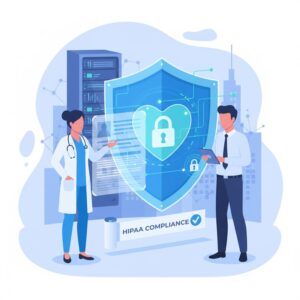
Every Covered Entity and Business Associate having access to PHI must implement relevant Technical, Administrative, and Physical safeguards to ensure the confidentiality, integrity, and availability of PHI.
This checklist should be reviewed at least annually, and whenever there are significant changes to systems, vendors, workforce roles, or data flows involving PHI.
2.Who Should Use This HIPAA Compliance Checklist
This checklist applies to:
-
Healthcare providers and hospitals
-
Health plans and insurers
-
Healthcare clearinghouses
-
Medical billing and coding companies
-
Cloud service providers and SaaS platforms handling PHI
-
IT and managed service providers supporting healthcare clients
Organizations typically use this checklist as a baseline assessment tool before conducting a formal HIPAA gap analysis or independent audit.
3.HIPAA Security Rule Checklist
The HIPAA Security Rule highlights the requirement for organizations to implement safeguards to protect electronic PHI (ePHI). The rule applies to all organizations that create, receive, maintain, or transmit ePHI.
The Security Rule requires the implementation of:
-
Technical safeguards
-
Physical safeguards
-
Administrative safeguards
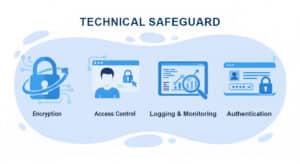
Technical Safeguard checklist
👉 Access Controls
Organizations must have identity and access management measures in place. Unique user IDs must be assigned to individuals accessing ePHI, and access must be restricted based on job roles.
Access rights must be reviewed periodically and immediately revoked upon employee termination or role change. Evidence of access reviews is frequently requested during audits.
👉 Authentication
Organizations must identify and authenticate users accessing ePHI and protect data from unauthorized alteration or destruction.
Multi-factor authentication is strongly recommended for remote access, cloud platforms, and privileged accounts and is increasingly expected during OCR audits.
👉 Encryption
ePHI must be encrypted when transmitted over external networks.While encryption at rest is addressable under HIPAA, regulators expect organizations to either implement it or maintain documented risk-based justification for not doing so.
👉 Logging and Monitoring
Organizations must establish logging and monitoring controls to track system activity.Audit logs must be reviewed periodically, and documented evidence of log reviews should be retained for compliance validation.
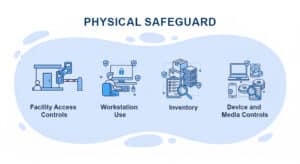
Physical Safeguard Checklist
👉 Facility Access Controls
Physical safeguards must restrict access to facilities where PHI is stored or processed.Visitor access logs and physical access reviews should be retained as evidence.
👉 Workstation Use
Policies must govern workstation usage and prevent unauthorized access.Remote and home-based workstations accessing ePHI must follow the same security controls as on-premise systems.
👉 Device and Media Controls
Policies must govern device use, disposal, and reuse. Evidence of secure data destruction or media sanitization is commonly requested during audits.
Administrative Safeguard Checklist
👉 Risk Assessment and Analysis
Organizations must conduct regular risk assessments to identify risks to ePHI.Risk assessments must be reviewed at least annually and updated after significant system, vendor, or operational changes. Lack of a current risk assessment is one of the most common causes of HIPAA enforcement actions.
👉 Staff Training
Employees must be trained on HIPAA security and privacy requirements.Training completion records must be retained and made available during audits.
👉 Security Responsibilities
Organizations must appoint personnel responsible for HIPAA security.Roles and responsibilities should be formally documented and approved by management.
👉 Contingency Plans
Organizations must maintain contingency and backup plans.Contingency plans should be tested periodically, and test results documented to demonstrate operational effectiveness.
👉 Third-Party Contracts
Business Associate Agreements must be in place.Organizations should periodically assess business associates for HIPAA compliance as part of third-party risk management.
For official reference, see the HHS HIPAA Security Rule Overview
4.HIPAA Privacy Rule Checklist
The HIPAA Privacy Rule governs the use and disclosure of PHI.Privacy policies must be reviewed periodically and updated to reflect operational changes, new data uses, or regulatory guidance.
The HIPAA Privacy Rule governs how PHI may be used and disclosed.
👉 Privacy Policies and Procedures
-
Organizations must maintain documented privacy policies
-
Policies must define permitted uses and disclosures of PHI
-
Policies should be reviewed and updated to reflect operational or regulatory changes
👉 Notice of Privacy Practices
-
Patients must be informed how their PHI is used and shared
-
Notices must be accessible and updated as required
👉 Individual Rights Management
-
Procedures must exist to respond to patient access requests
-
Requests must be fulfilled within regulatory timelines
-
All requests and responses should be documented
👉 Minimum Necessary Standard
-
PHI use and disclosure must be limited to the minimum necessary
-
Access justifications should be documented for sensitive roles
For official reference, see the HHS HIPAA Privacy Rule Summary
5.HIPAA Breach Notification Rule Checklist
HIPAA Breach Notification Rule is about having a process in place to notify patients when there is a breach of their PHI. The rule also requires a process that ensures prompt notification to the Department of Health and Human Services (HHS) of such a breach of PHI and further issues a notice to the media in case the breach has affected more than five hundred patients. So, here is a list of measures one must consider-
- Establish an Incident Management Plan
- Have in place Policies and Procedures concerning Data Breach Response
- Have in place Policies and processes for notifying Individuals or patients affected.
- Have in place Policy and process for promptly notifying HHS
- Establish a process to notify the media about the data breach in case it has affected more than 500 patients.
For official reference, see the HHS Breach Notification Rule.
6.Common HIPAA Audit Failures Observed by Regulators
-
No documented risk analysis
-
Outdated or generic policies
-
Incomplete Business Associate Agreements
-
Lack of encryption evidence
-
No proof of workforce training
-
Incident response plans not tested
Addressing these areas proactively significantly reduces audit and enforcement risk.
7.How Often Should HIPAA Compliance Be Reviewed
HIPAA compliance is not a one-time activity. Organizations should:
-
Review compliance annually
-
Reassess after system changes, mergers, or vendor onboarding
-
Validate controls after security incidents
Reviewed by HIPAA compliance auditors at VISTA InfoSec with over two decades of experience supporting healthcare organizations, business associates, and healthcare technology providers with HIPAA risk assessments, audits, and remediation programs.
8.How VISTA InfoSec uses this HIPAA checklist during audits
During an engagement, our auditors use a checklist to map HIPAA Privacy, Security, and Breach Notification Rule requirements against the organization’s existing administrative, physical, and technical safeguards. This approach allows us to systematically identify gaps, assess risk exposure to PHI/ePHI, and determine whether controls are adequately designed and effectively implemented.
The checklist also helps structure evidence collection, stakeholder interviews, and technical validation activities, such as access control reviews, risk analysis evaluations, incident response testing, and security awareness assessments. Findings from this process are then prioritized based on risk and regulatory impact to support remediation planning and audit readiness.
9.FAQ
What is a HIPAA Compliance Checklist?
A HIPAA compliance checklist is a preparatory and administrative guide that helps healthcare organizations and business associates handling healthcare data implement the required administrative, technical, and physical safeguards to protect PHI and meet HIPAA regulations.
Who needs to comply with HIPAA?
Every covered entity, such as hospitals, clinics, insurers, and healthcare clearinghouses, is required to comply with HIPAA. Business associates (vendors and service providers handling PHI) are also required to comply under contractual and regulatory obligations.
How often should a HIPAA Risk Assessment be done?
At least once every year, and after any major system, vendor, or infrastructure changes, to remain aligned with OCR guidance and enforcement priorities.
What happens if an organization fails to comply with HIPAA?
HIPAA non compliance can lead to civil penalties, reputational damage, and even criminal charges. Fines can range from a few thousand dollars to over $1.5 million per year of violation, depending on the severity and intent.
Final Thought
HIPAA Compliance is an ongoing process that organizations must review frequently. For those new to this and looking to achieve HIPAA Compliance, we strongly recommend considering the above-listed checklist. While those who are compliant and looking to stay compliant must frequently review their processes and update the existing policies, and procedures in alignment with the changing environment to meet the HIPAA requirements. Further as a final word of recommendation we suggest organizations consult compliance experts on ways of achieving and maintaining HIPAA Compliance.
📞 Need Expert Guidance?
Vista InfoSec helps healthcare organizations and service providers build, test, and maintain HIPAA compliance programs.
Our certified auditors and consultants can help you:
-
Perform risk assessments
-
Draft policies and BAAs
-
Prepare for OCR audits
-
Implement continuous compliance monitoring
📅 Schedule your HIPAA Audit Consultation → Contact Vista InfoSec

Narendra Sahoo (PCI QSA, PCI SSFA, CISSP, CISA, CRISC, 27001 LA) is the Founder and Director of VISTA InfoSec, a global information security consulting firm. With 21 years of experience in information security consulting, assessment and compliance services, Narendra has helped organizations address complex cybersecurity and regulatory requirements across global markets.

